Strictly Necessary
Required for login, session management, account security, device limits, referral functionality and remembering your cookie choice.


Why football odds fall, how to measure a price movement, what it means for Over 2.5 goals and Asian handicaps, and why a dropping price is not a guaranteed prediction.
A football team opens at odds of 2.40. A few hours before kick-off, the same selection is priced at 2.00. Did someone discover an important piece of information? Is the team suddenly more likely to win? Or is the bookmaker simply reacting to betting activity?
This is what traders and bettors call dropping odds (or falling odds): the decimal price offered for a particular selection becomes shorter over time.
The movement is worth understanding. But it is not proof that the selection will win, nor does it automatically mean the current price is good value.
In decimal-odds markets, dropping odds means that the payout price for the same selection has declined. For example:
| Time | Home win odds | Implied probability* |
|---|---|---|
| Market opens | 2.40 | 41.7% |
| Day before kick-off | 2.20 | 45.5% |
| One hour before kick-off | 2.00 | 50.0% |
*The implied probabilities are calculated as 100 ÷ decimal odds. They include the bookmaker's margin and are not independent estimates of the true chance.
As the price falls, the break-even probability required by the offered price increases. This does not mean the team's actual chance rose by exactly the same amount. A bookmaker's prices reflect several factors, including its margin and risk management.
The opposite movement is known as drifting odds: the selection's price becomes longer, such as 2.00 → 2.30.
Injuries, suspensions, squad rotations and confirmed starting elevens can change the market's assessment of a fixture. A price may move quickly after relevant news appears.
Bookmakers may react to the amount and nature of betting activity, move their prices to manage exposure, or follow changes at other bookmakers. A drop does not reveal who placed the bets or whether those bets were well informed.
More information often becomes available as kick-off approaches. But late movement is not automatically more reliable than early movement, especially in thin or volatile markets.
Two bookmakers can quote different prices for the same outcome. A price change at one operator may partly reflect a change to its margin or pricing policy rather than a meaningful shift in estimated probability.
Key lesson: the reason behind a price change matters more than the simple fact that the odds moved.
Imagine a hypothetical home-win price falls from 2.40 to 2.00.
These are two different measurements: a 16.7% reduction in the quoted odds and an 8.3-percentage-point increase in the raw implied probability. They should not be confused.
Suppose a two-outcome market lists Over 2.5 at 1.90 and Under 2.5 at 1.90. Each quote implies approximately 52.63%. Together, they imply 105.26%, not 100%. The excess is the market's overround, often used as a measure of bookmaker margin.
That is why raw implied probabilities cannot be treated as true probabilities without further analysis. Even after removing margin, the result remains a market estimate, not a certainty.
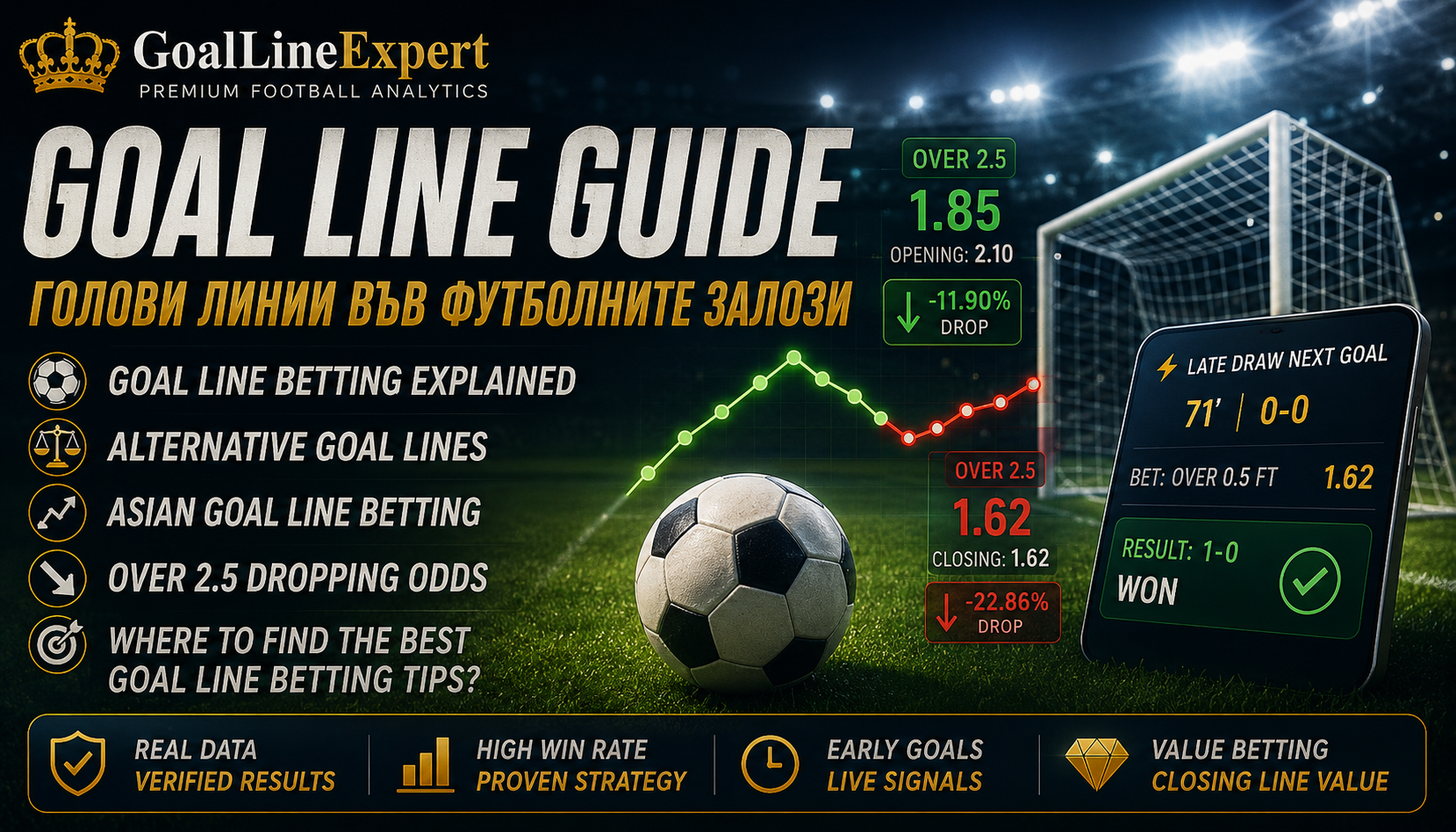
The Over 2.5 goals market wins if the match finishes with at least three total goals. When its price falls before kick-off, the market is offering a smaller return for that outcome.
| Illustrative snapshot | Over 2.5 | Under 2.5 |
|---|---|---|
| Earlier | 2.05 | 1.80 |
| Later | 1.85 | 2.00 |
Fictional example for explanation, not a real fixture or an actual betting opportunity.
Here, the Over 2.5 price shortened while the Under 2.5 price drifted. The market's relative pricing moved towards the Over outcome. But a betting decision would still require context:
Crucial distinction: an outcome becoming more strongly favoured by the market is not the same as that outcome becoming a profitable bet.
Asian handicap markets add another layer: both the handicap line and the price can move.
| Example | Earlier | Later | Interpretation |
|---|---|---|---|
| Same line, shorter price | Team A −0.5 @ 2.00 | Team A −0.5 @ 1.85 | The price fell for the same handicap selection. |
| Line changed | Team A −0.5 @ 1.90 | Team A −0.75 @ 1.95 | The handicap itself changed; the selections are not directly equivalent. |
Illustrative prices only.
Do not compare 1.90 on −0.5 with 1.95 on −0.75 as if they were the same bet. A −0.75 handicap has different settlement rules, including a split-stake result when the team wins by exactly one goal. Always keep the line, market, time and bookmaker consistent when analysing movement.
Live prices move for obvious reasons: goals, red cards, penalties, the remaining playing time and the current score can all alter the available market. This makes a live price drop different from a pre-match move.
Imagine a match is 0–0 after 25 minutes. A live Over 2.5 price might drift even if one team has had several shots, simply because there is less time left for three goals. Alternatively, an important event can cause a sudden repricing.
Useful live-analysis questions include:
Do not confuse market movement with match momentum. Odds describe a price. Statistics describe recorded match events. Neither alone guarantees what happens next.
An odds alert may be a reason to investigate. It is not a reason to abandon a pre-defined staking limit.
A useful workflow starts with a question, not a prediction: What does the market movement suggest, and do the match statistics support or challenge that interpretation?
GoalLineExpert provides football fixtures, statistical trends, head-to-head context and selected match-analysis tools. These can help readers investigate football matches from several angles. GoalLineExpert should not be assumed to provide a dedicated historical dropping-odds tracker: the odds movements in this article are educational examples, not data produced by such a feature.
For related reading, explore our guide to live betting signals, the bankroll management guide and our betting strategies overview. The linked article availability and language should be checked before publishing.
No. A price drop alone is not evidence of match fixing. Odds may move because of routine information, betting activity or bookmaker adjustments. Serious allegations require independent evidence.
No. A shorter price corresponds to a higher raw implied probability, but outcomes remain uncertain and the quoted price includes a bookmaker margin.
They can indicate a change in the market's price for Over 2.5. They do not establish whether three goals will be scored or whether the latest odds offer good value.
Dropping odds shorten, such as 2.20 → 1.95. Drifting odds lengthen, such as 1.95 → 2.20.
Yes. Betting flows, competitor prices, trading decisions and margin adjustments can all contribute.
No. Treat alerts as starting points for investigation. A price move cannot remove uncertainty, and betting always carries financial risk.
Dropping odds tell you that a quoted betting price has changed. They do not tell you with certainty why it changed, whether the outcome will occur, or whether the new price is worth taking.
Good analysis separates three questions: What changed in the price? What changed in the available information? Does the current price make sense? Keeping those questions separate is more useful than blindly following any falling-odds list.
This article is for educational and informational purposes only. It does not provide guaranteed predictions or financial advice. Betting involves risk, and losses are possible regardless of statistical analysis. Never chase losses, set limits you can afford, and seek support if gambling is becoming difficult to control. For more information, see our responsible gambling information .